
Interview with the OQ SOLUTION Team
Since becoming an official Blickfeld partner earlier this year, OQ SOLUTION has been bringing 3D LiDAR technology to industrial customers across South Korea. Through customer demonstrations, proof-of-concepts, and real-world projects, the team has gained valuable insights into emerging LiDAR applications, evolving customer expectations, and the growing demand for practical, ready-to-use solutions.
In this interview, OQ SOLUTION shares why they chose to partner with Blickfeld, how customers are adopting LiDAR in industrial environments, and where they see the greatest opportunities for the technology in South Korea and the wider APAC region.
Could you briefly introduce OQ SOLUTION?
OQ SOLUTION is a Korea-based company founded in August 2021 by CEO Jay Park, focused on physical AI and physical security. We work as partner for sensor technologies including 3D LiDAR (Blickfeld), self-cleaning cameras, gated cameras, and airborne multispectral sensors, along with software solution, ASO (Automated Sensor Operator). Our customers span aviation safety & disaster response, security & surveillance, heavy chemical & steel, marine & offshore plants, and special mobility. Our background also includes aviation parts and MRO services, where the same emphasis on precision and reliability carries over into our current work.
Through these technologies, we’re working toward a smarter, safer world, one where physical spaces and critical operations are protected and optimized through reliable, real-time sensing.
Why did you decide to add LiDAR to your portfolio?
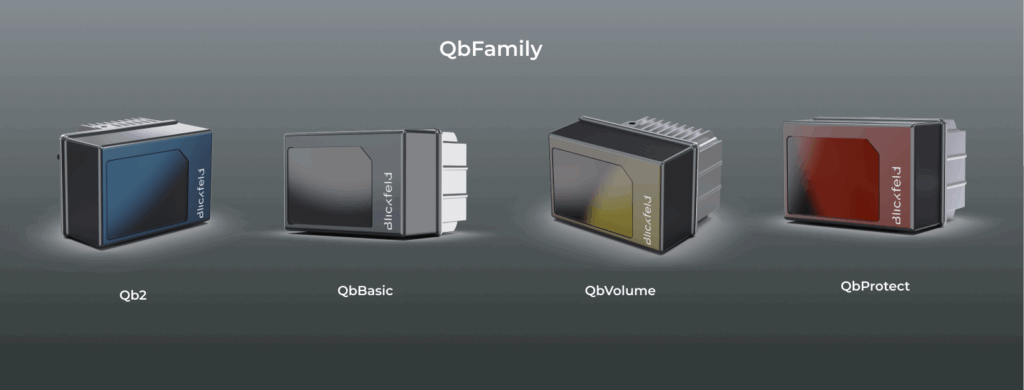
The biggest appeal of Blickfeld is that hardware and software come fully integrated. Most existing LiDAR products stop at providing point cloud data output, a viewer, and an API. With that approach, customers still need to handle additional development or post-processing on their own before they can apply it to real-world operations.
Blickfeld, on the other hand, goes beyond hardware to offer ready-to-use applications for real industrial use cases, such as volumetric measurement and security surveillance. This means even customers with little prior LiDAR experience can immediately see how it applies to their site, and we can position it not just as a sensor, but as a genuine solution. We saw that as a strong competitive advantage, which is why we decided to add it to our portfolio.
What aspects of the collaboration with Blickfeld have been particularly valuable for your team and customers?
A few things stand out. First, the training Blickfeld has given our sales team. It lets us speak confidently with customers and answer technical questions directly, without escalating every query back to the Blickfeld team.
Second, their responsiveness. Whenever we need technical support during demo prep or on-site, we get fast, clear answers, which keeps customer momentum going.
Finally, as their official Korean partner, Blickfeld passes along any inquiries they receive from Korean customers directly to us, a real sign of partnership. Together, this gives our customers confidence that they’re getting expert guidance, not just a sales pitch, which is what makes the collaboration valuable on both sides.
How do you assess the current adoption of LiDAR technology in South Korea?
LiDAR adoption in South Korea is gradually expanding. In the past, interest in LiDAR was concentrated mainly on autonomous driving, robotics, and surveying/mapping. More recently, we’ve seen a growing number of cases where manufacturing and industrial sites are also exploring how LiDAR could be applied.
What we find particularly notable is the shift in the kinds of questions customers ask. In the past, most questions centered on hardware specs like “What is LiDAR?”, “What’s the point density?”, or “What’s the measurement range?” Lately, we’re hearing more questions like “Can LiDAR solve the problem we have on-site?”, “Can it integrate with our existing systems?”, and “How would this actually apply to our operations?”
We take this as a sign that the Korean LiDAR market is moving from a stage of pure technical evaluation to one of actual deployment. As the market rapidly expands from being centered on autonomous driving and robotics toward industrial site applications, we believe LiDAR solutions built for real-world industrial use, like Blickfeld’s, are well positioned to compete in that shift.
In your experience, what advantages does LiDAR offer compared to traditional technologies such as cameras, radar, or other sensors?
The biggest advantage of LiDAR is that it can directly perceive three-dimensional space. While cameras are primarily strong at providing 2D image data, and radar excels at detecting object presence and distance, LiDAR provides 3D spatial information distance, shape, height, and volume in a much more intuitive way.
Because of this, LiDAR is well suited to applications like volumetric measurement, object detection, and spatial monitoring. Since it captures real-world space as 3D data that can be analyzed directly on the device, it allows for a much more accurate understanding of shapes and changes on-site that were difficult to capture with conventional sensors.
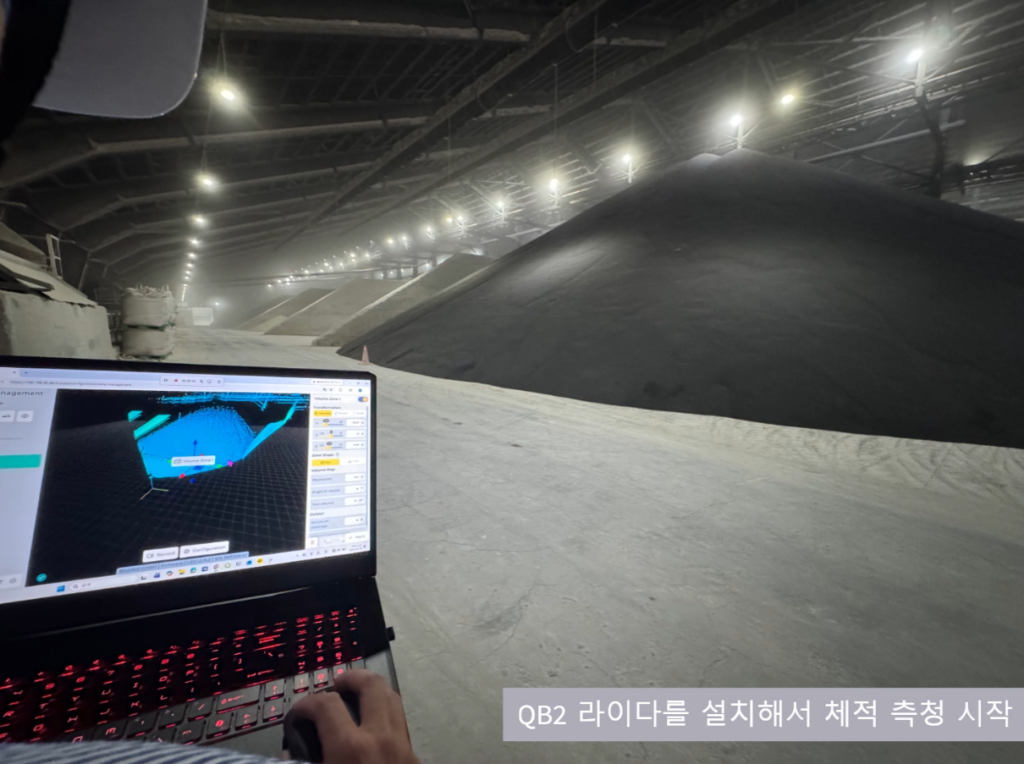
Building on this advantage, we’ve been focusing on bulk inventory management. In past demonstrations including bulk inventory measurement at a fertilizer plant and raw material inventory measurement at a smelting plant, customers responded positively to being able to visually check the shape and volume of material piles through LiDAR.
Which applications generate the strongest customer interest today?
The area generating the most customer inquiries right now is inventory management, particularly volumetric measurement at fertilizer plants and raw material volume measurement at smelting facilities. Interest is especially strong at industrial sites that store large quantities of raw materials or finished products, such as outdoor stockyards, raw material warehouses, and bulk material storage facilities.
At many of these sites, inventory is still managed based on worker experience, visual judgment, manual measurement, or periodic external surveying. Customers are interested in using LiDAR to automate this process and build a more accurate, real-time inventory management system.
We’ve also seen interest in the security surveillance space. For example, we introduced Blickfeld LiDAR to Incheon International Airport, and there have been cases examining its applicability for intrusion detection in environments where visibility is limited, such as at night or in fog.
Are there any particularly innovative or unexpected use cases that have emerged in your discussions with customers?
The ongoing overhead crane application case with Yujing Tech is one we find particularly interesting. At that site, a laser measuring device is currently mounted on the crane to measure the height of raw materials, and this data is used to determine where the bucket should operate. However, this conventional method only measures specific points or limited lines, which limits its ability to capture the full shape of the entire material pile.
By applying Blickfeld LiDAR, we can recognize the full shape of the material pile in 3D and use that to determine the optimal position for the bucket to operate. At the same time, since it also enables volumetric measurement of the material, there’s potential to combine crane automation with real-time inventory management.
What makes this case innovative, we think, is that it moves beyond the conventional approach of mounting LiDAR in a fixed position for monitoring or measurement and instead integrates LiDAR with moving industrial equipment.
How does OQ SOLUTION help customers integrate LiDAR into their existing infrastructure and workflows?
We start by meeting with the customers to understand their requirements and how they currently operate. After that, we visit the site to review the installation environment, what needs to be measured, potential obstacles, network setup, existing systems, and the workflow of on-site workers.
Based on this, we analyze the expected benefits of applying Blickfeld LiDAR and propose the appropriate installation location, sensor configuration, demonstration approach, and scope of application. If the customer already has a system in place, we also work with them to figure out how LiDAR data or Blickfeld’s software output can be integrated.
In other words, OQ SOLUTION doesn’t just supply the LiDAR hardware — we support customers through site analysis, demonstration, results review, and system integration planning, so they can put LiDAR to use within their real operational processes.
What feedback have you received after demonstrating LiDAR-based solutions to your customers?
The most common positive feedback we’ve received is that customers can quickly verify real-world applicability without taking on additional development work.
Most of our customers don’t have much prior experience with LiDAR, which is why many of them feel uneasy about a workflow where they’d only receive point cloud data and must handle the rest of the development themselves. Since Blickfeld provides applications like volumetric measurement and security surveillance built in, customers were able to intuitively grasp the practical value of LiDAR.
Most customers were satisfied with the demonstration results, but some did express concern about the cost of adoption. Industrial sites tend to have complex layouts with obstacles and blind spots, which can mean multiple LiDAR units are needed in some cases. This can increase the initial investment, so we work with customers to review the actual scope of application and expected benefits together and propose a realistic approach to adoption.
If a customer asked why they should consider Blickfeld, what would you tell them?
Blickfeld isn’t just a LiDAR sensor, it’s a LiDAR solution that can be applied directly to industrial sites.
We’ve worked with a variety of LiDAR systems over time, including terrestrial LiDAR, aerial LiDAR, and MMS, and in most cases, the product requires separate post-processing, software development, and analysis by specialized personnel after the data is captured. This means it can take a long time before customers can apply it to their operations, and the burden of adoption can be significant.
Blickfeld, on the other hand, comes with practical software built in alongside the hardware, applications like volumetric measurement and security surveillance. So, customers can go beyond simply viewing LiDAR data and put it to direct use in solving real on-site problems.
We no longer emphasize hardware specs alone, things like “how many points it captures” or “what the measurement range is.” Instead, we focus on explaining, from the customer’s perspective, what problems Blickfeld solves, how it improves their existing workflows, and what tangible results they can expect.
For customers who want to adopt LiDAR on-site but are concerned about the burden of additional development or complex post-processing, we believe Blickfeld is a very practical and realistic choice.
Thanks to the OQ SOLUTION Team!