Distance Monitoring for Preventive Bridge Protection

Volkmann Straßen- und Verkehrstechnik relies on LiDAR technology to reduce the load on the Moseltal Bridge

Overview

A large proportion of highway bridges in Germany are currently considered in need of renovation. While many structures are being repaired step by step, those bridges whose renovation is still pending must be operated safely for as long as possible. As a result, the focus is increasingly shifting toward preventive measures to protect existing structural assets.

One key lever is the reduction of mechanical stress on the bridge. The objective is to minimize both the total load and the dynamic vibrations at the so-called contact point. Heavy goods traffic is particularly critical in this context: the load exerted by a single truck is exponentially higher than that of passenger vehicles. In addition to speed, the distance between trucks plays a decisive role in reducing the impact on the bridge structure.

At the Moseltal Bridge on the A61, Volkmann Straßen- und Verkehrstechnik, under the project management of Traffic-Lines, therefore deploys Blickfeld 3D LiDAR sensors to measure the distance between trucks and to inform vehicles that are following too closely of the required minimum distance.


Traffic Monitoring Volkmann Moseltal
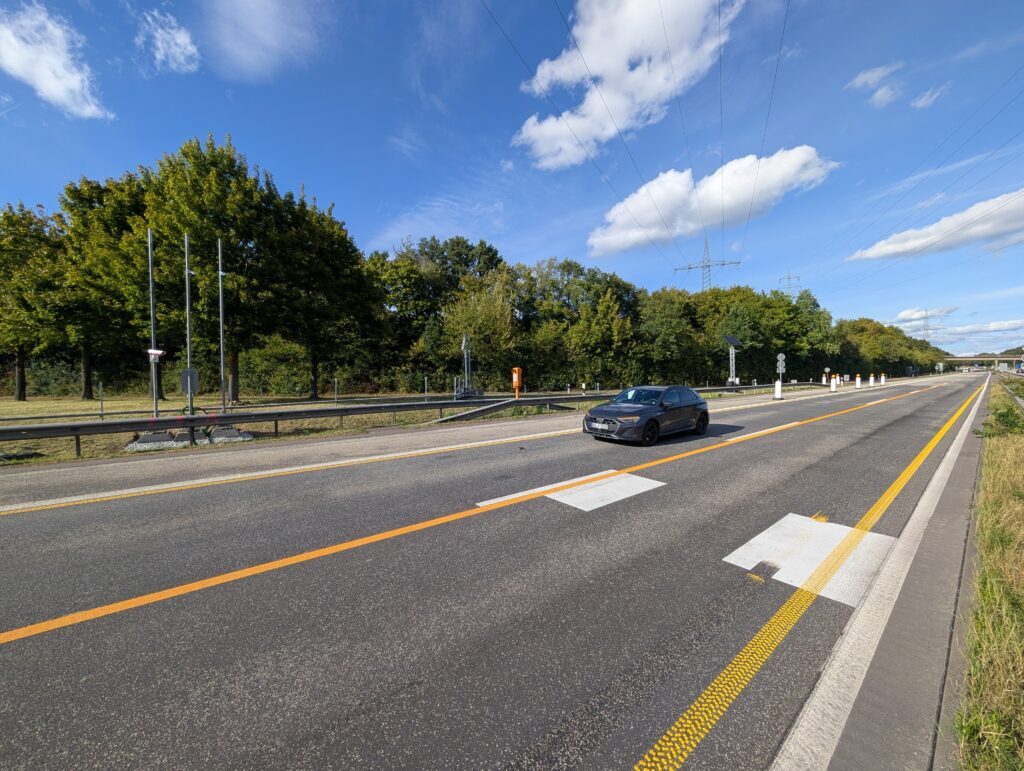
Blickfeld Qb2 sensors are mounted on poles beside the highway, without installation interrupting ongoing traffic.

Challenge

The central requirement for the preventive protection of the Moseltal Bridge was clear: trucks must maintain a minimum distance of 50 meters in order to reduce stress on the bridge structure. From a technical perspective, this posed a challenge. Existing distance measurement solutions are predominantly based on complex video systems, which quickly raise data protection concerns.The goal was therefore to find a data protection–compliant, permanently installed solution that reliably captures vehicle distances day and night and is suitable for continuous operation on a highly frequented highway.

Solution


The solution implemented by Volkmann is based on a setup combining 3D LiDAR and an ANPR camera (Automatic Number Plate Recognition, not capturing drivers’ faces), installed approximately 400 meters before the bridge and specifically monitoring the right-hand lane.

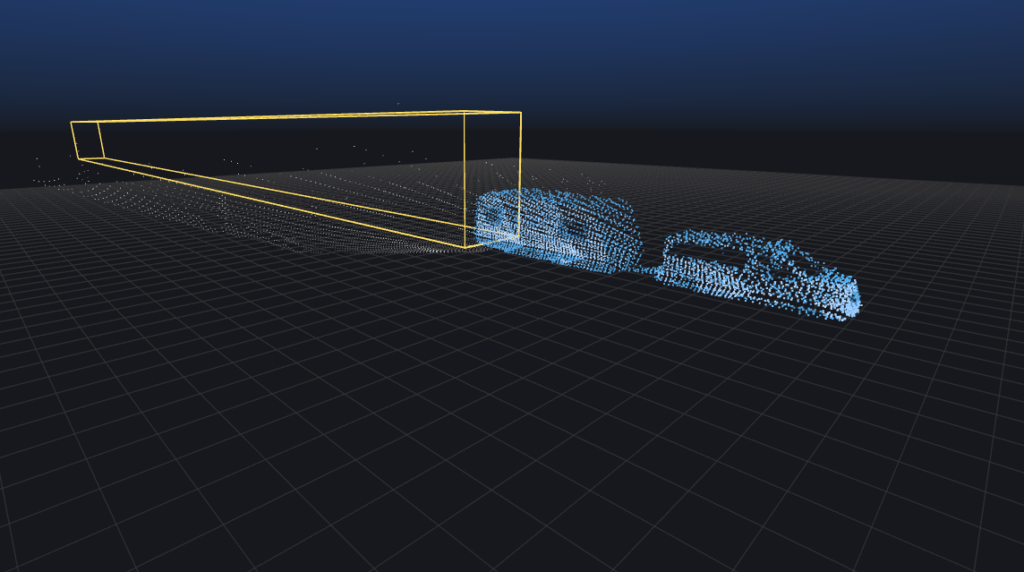
The deployed Blickfeld Qb2 LiDAR sensor captures the traffic environment in three dimensions and is capable of detecting and classifying vehicles as well as determining the distance between successive trucks. If a vehicle falls below the defined minimum distance of 50 meters, the driver is informed immediately: an electronic display shows the license plate of the respective truck and indicates the required minimum distance.

The aim of this setup is to create increased awareness through transparency and direct feedback, enabling drivers to self-correct their behavior. The concept itself is well established: most road users are familiar with this principle from speed display signs, for example at town entrances or in 30 km/h zones.
Volkmann’s decision to use Blickfeld LiDAR sensors was driven not only by their versatile performance in traffic applications (detection, classification, distance measurement), but also by the ease of installation. The scanner can be mounted at the roadside rather than as an overhead system. As a result, only sensor alignment is required, without additional structural measures such as special road markings.

Results

The system operates stably and reliably and meets the technical requirements in live operation. Distance measurement functions independently of time of day and weather conditions and delivers consistent results.

The desired effect on driving behavior – particularly more conscious deceleration and the maintenance of larger distances by truck drivers – continues to be monitored. Initial observations suggest that the increased awareness is having an effect. As with comparable measures, it can be assumed that the full impact will develop as drivers become more accustomed to the system.


Blickfeld Qb2 with traffic software reliably classifies vehicles according to 8+1 classification.
What the Blickfeld LiDAR sensor achieves is truly a top-tier capability. Reliable vehicle detection alone is already a demanding task, but the algorithm goes further by classifying vehicles and determining the distance between them. It supports the 8+1 vehicle classification commonly used in Germany, which significantly exceeds the four-category classification typically derived from point cloud data.
Dr. Marcel Vosshans
R&D – Intelligent Software Systems

Outlook

Based on the positive experience at the Moseltal Bridge, the implementation of an additional bridge installation is already planned. The project demonstrates how modern sensor technology can make a significant contribution to the preventive protection of infrastructure: pragmatic, scalable, and with a clear focus on sustainability and safety in existing assets.

Share Case Study
Facebook
Twitter
LinkedIn
XING
WhatsApp
Email
Contact

Contact us to discuss your application!

Search